Software
Octofitter
Octofitter is a large set of packages I created with the goal of advancing the current state of orbit fitting. Octofitter is built from the ground-up for extremely high performance and differentiable computing. Using Octofitter, challenging orbit models which previously would require hours or days, can now be sampled in seconds or minutes.
This speed enables researchers to approach their modelling tasks with a new level of rigour, and following a full Bayesian workflow. One can—in less than the time it used to take to run a single model—compare how different individual data points impact a fit, compare how priors affect the results, or even run full suites of simulated fits to anticipate how new data would impact findings.
Octofitter supports an ever-growing list of kinds of exoplanet data. At present, these include:
- Relative astrometry, e.g. from direct imaging
- Absolute astrometry: Hipparcos intermediate data, the Hipparcos-Gaia proper motion anomaly, and the full G23H model of Gaia DR2, DR3 and Hipparcos
- Barycentric radial velocity (e.g. of a star), with optional Gaussian process models of stellar activity
- Relative radial velocity (e.g. of a planet relative to its star)
- Relative and absolute photometry
- Direct images, sampled directly ("de-orbiting")
- Interferometric closure phases and squared visibilities, e.g. from sparse aperture masking (NIRISS-AMI) or GRAVITY
- Arbitrary x vs. y likelihood maps e.g. from GRAVITY, spectral cross correlation, etc.
- Some spectral modelling features, e.g. to support GRAVITY data
- Any number of planets, including transdimensional models that marginalize over the number of planets
- Optional N-body integration, and hierarchical systems such as moons, circumbinary planets, and 2+2 quadruples
- Tie dynamical masses and photometry together through age & cooling tracks
- Specify custom priors, including multivariate priors with correlations, etc.
- Specify prior distributions using kernel density estimates (just pass raw samples).
- Freely transform variables to different bases
- Bound and unbound (hyperbolic) orbits
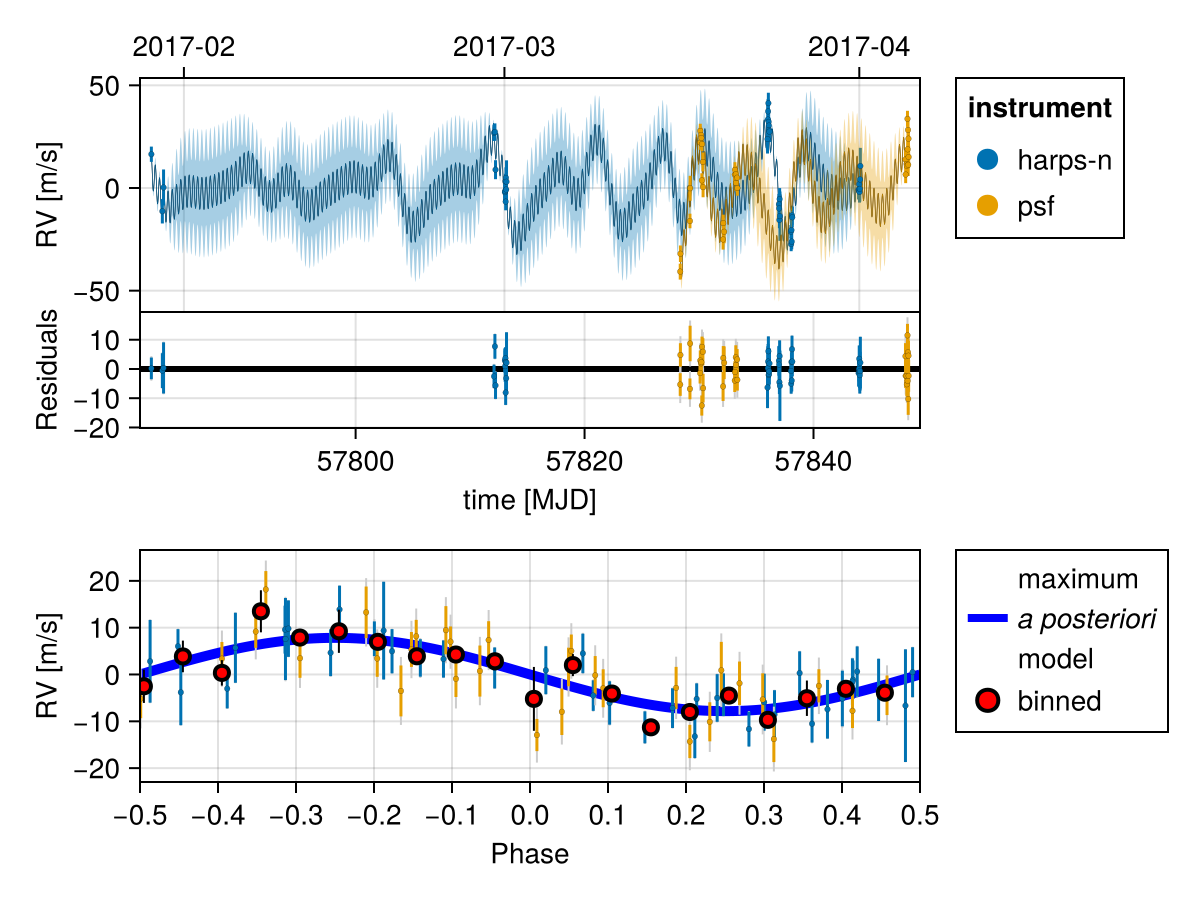
Exopost
Exopost is a public website for exploring companion posteriors from Octofitter and G23H. For more than 100,000 stars you can browse orbits and masses, view detection limits, filter the catalogue, and download the posterior samples for your own analysis. Queries run directly in your browser using DuckDB.
The calibrated Gaia DR2 catalog for 18 million stars that underlies G23H is described in Thompson et al. 2026.
PairPlots
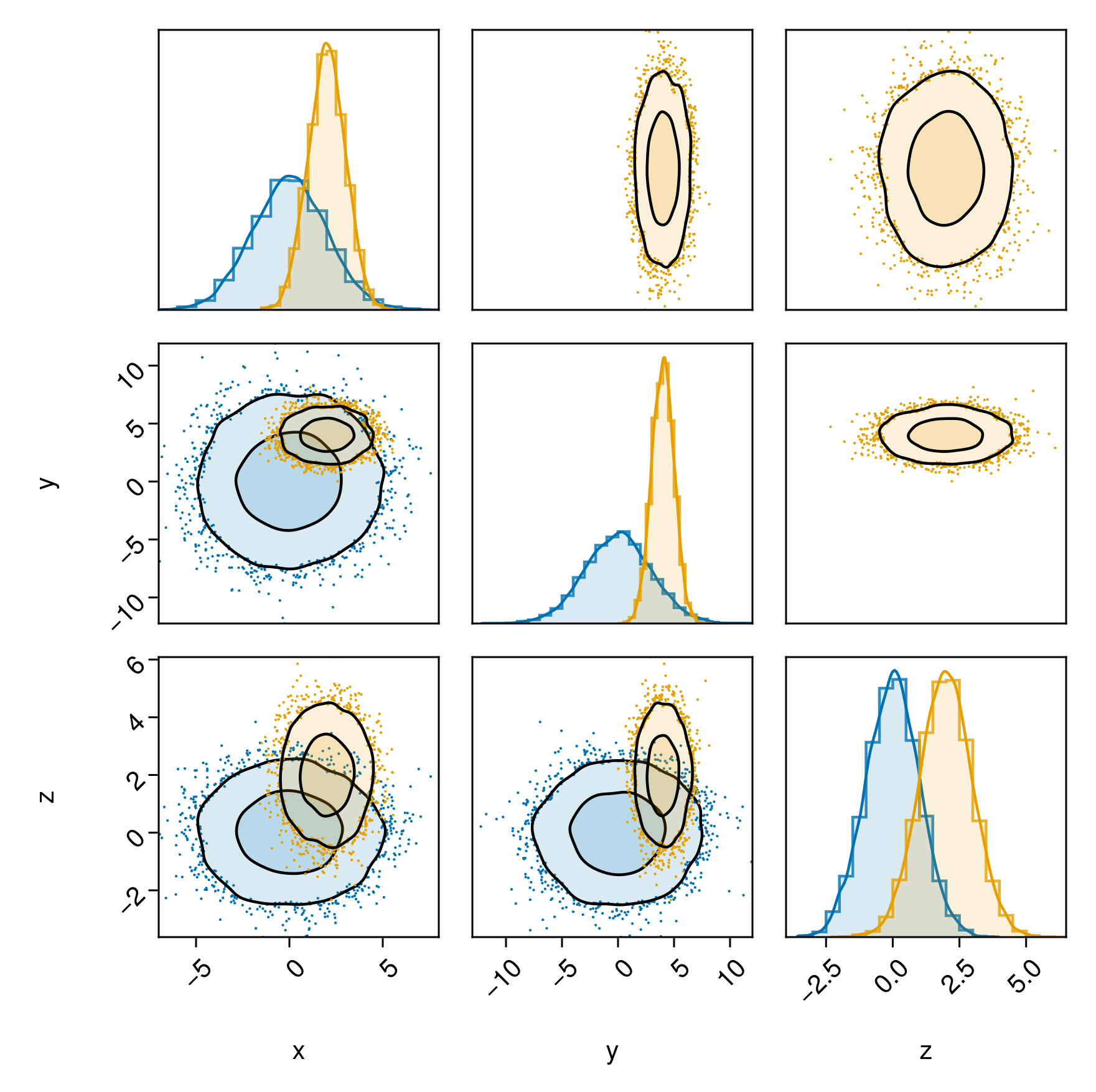
PairPlots is a Julia and Python package for generating pair plots, also known as corner plots. Inspired by the very popular Python package corner.py, this package produces highly customizable visualizations to compare high-dimensional data e.g. Markov-chain monte carlo posteriors.
PlanetOrbits
PlanetOrbits.jl is the calculation backend for Octofitter. It provides an easy interface to a large suite of different orbit calculations, and is fully auto-differentiable.
PlanetOrbits.jl supports many different kepler solvers with varying accuracies and number types (e.g. Float-16, Float-32, Float-64, and arbitrary precision). Bound and unbound (hyperbolic) orbits are supported.
AstroImages
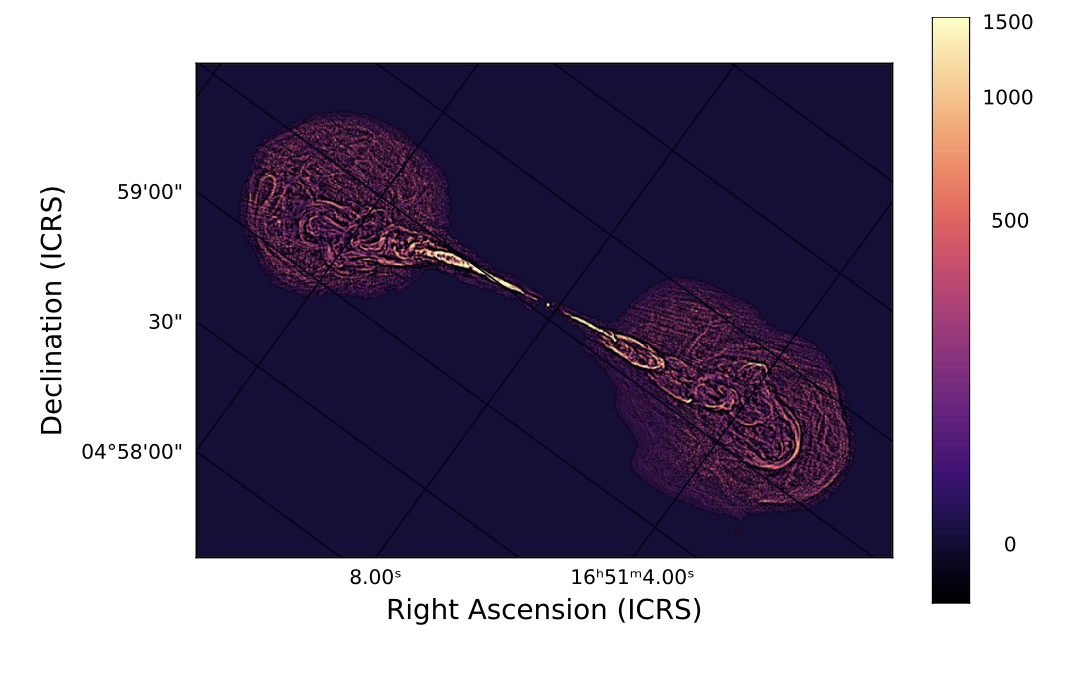
AstroImages.jl is a package for loading and displaying FITS files, complete with support for world coordinate systems. It's very simple to use:
img = load("myfile.fits",1)
img["HEADER1"] = 1.0
img["HEADER1",/] = "comment 1"
imview(img, stretch=logstretch)
JuliaAstro
I help maintain some of the Julia Astro packages, and the main documentation and tutorial site: juliaastro.org.Julia RTC
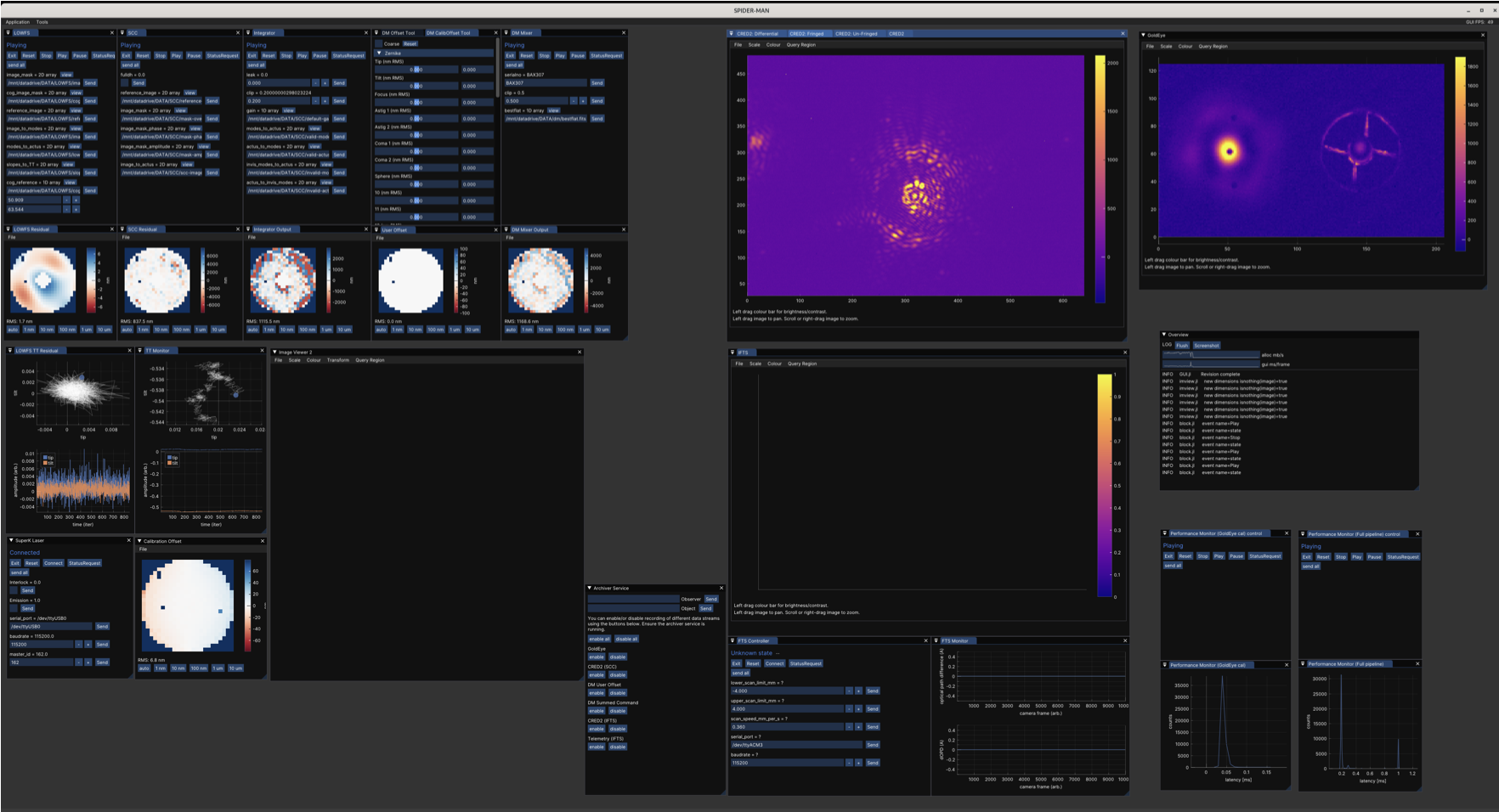
For the SPIDERS instrument, I developed a Julia-based real-time computing framework. It is based around the ultra-low-latency aeron messaging framework developed for high-frequency trading.
Our Julia RTC framework is competitive with hand-written C, but far easier to use.
You can read more about the framework in our SPIE proceeding: https://arxiv.org/abs/2407.07207.
Last updated October 2026
🐙