Astrometry: Finding Planets by Watching Stars Move
Astrometry is the measurement of where stars are on the sky, and of how those positions change over time. It is the oldest branch of astronomy: Hipparchus compiled a star catalogue more than 2,000 years ago. Thanks to the European Space Agency's Gaia mission, it is now also one of the most exciting new ways to find planets.
Why stars move
Over the years, a star's position on the sky changes for three main reasons.
- Proper motion. The star and the Sun both move through the Galaxy, so the star slowly drifts across the sky in a nearly straight line. Nearby stars typically drift by tens to hundreds of milliarcseconds each year.
- Parallax. As Earth orbits the Sun, our viewpoint shifts, and nearby stars appear to trace a small ellipse once per year. The size of that ellipse gives the star's distance. A star 10 parsecs (about 33 light-years) away has a parallax of 100 milliarcseconds.
- Orbiting companions. A star with a planet does not sit still at the centre of its system. The star and planet both orbit their common centre of mass, so the star traces out a tiny copy of the planet's orbit, scaled down by the ratio of their masses.
Together, these give a star with a planet a looping, wobbling path across the sky. Finding the planet means measuring that path precisely enough to separate the planet's tiny contribution from the much larger effects of proper motion and parallax. Try it below: turn the effects on and off, and change the mass of the planet.
How big is the wobble?
The size of the star's wobble on the sky depends on the planet's mass compared with the star's, on the size of the planet's orbit a, and on the distance to the system d:
For Jupiter and the Sun, seen from 10 parsecs, that comes to about half a milliarcsecond (mas). That is roughly the width of a loonie seen from the other side of the Earth. Earth's effect on the Sun is more than 1,500 times smaller still.
| Seen from 10 parsecs | Size of the star's wobble |
|---|---|
| A 10 Jupiter-mass planet at 5 au from a Sun-like star | 4.8 mas |
| Jupiter and the Sun | 0.50 mas |
| Saturn and the Sun | 0.27 mas |
| Earth and the Sun | 0.0003 mas |
| For comparison | Precision |
| Hipparcos positions of bright stars (1990s) | ~1 mas |
| Gaia DR3 parallaxes of bright stars | ~0.02 mas |
Notice that the wobble grows with the size of the orbit. That is the opposite of the other main detection methods: radial-velocity signals shrink for wider orbits, and transits become rarer. Astrometry is therefore most sensitive to giant planets at the distances of Jupiter and Saturn, as long as we watch long enough to see the orbit bend. That can take a while: Jupiter takes 12 years to orbit the Sun, and Saturn takes 29.
Hipparcos and Gaia
Two European Space Agency missions make this possible today. Hipparcos (1989–1993) measured the positions of about 118,000 bright stars to about one milliarcsecond. Gaia, launched in December 2013, observed nearly two billion stars until it finished science observations in January 2025. For bright stars it is tens of times more precise than Hipparcos.
Gaia's earlier data releases, DR2 (2018) and DR3 (2022), did not include each star's individual measurements. Instead they reported a summary: a single position, parallax, and proper motion for each star. Even so, those summaries can reveal planets. Comparing a star's Hipparcos position from 1991 with its Gaia position from 2016 gives its average motion over 25 years. If that long-term average differs from the short-term proper motion measured by either mission on its own, something is pulling on the star. This difference is called the proper motion anomaly (see e.g. Brandt 2021 and Kervella et al. 2022). It has pointed the way to several directly imaged planets and brown dwarfs.
In G23H, my collaborators and I combined these and several other summary measurements into a single model. These include calibrated Gaia DR2 data, the Hipparcos intermediate astrometric data, and the excess noise in Gaia's fits. That lets us fit full orbits using only data that already exists. In some cases, like the planet 14 Herculis b, it can confirm a planet from Gaia and Hipparcos alone. You can browse the results for more than 100,000 stars on Exopost.
Gaia DR4: the next big step
Gaia's fourth data release is scheduled for 2 December 2026. It covers the first 5.5 years of the mission and, for the first time, includes the epoch astrometry: dozens of separate position measurements for each star. Instead of a summary, we will be able to see each star's path directly, and fit orbits to it. Predictions suggest that DR4 will reveal thousands of giant planets (e.g. Perryman et al. 2014). A final release, DR5, covering all 10.5 years of observations, is expected no earlier than the end of 2030.
DR4's 5.5-year window is ideal for planets with orbits of a few years. For wider orbits like Jupiter's and Saturn's, Gaia alone will only see part of each orbit. Combining it with Hipparcos, the earlier Gaia releases, radial velocities, and imaging will remain essential.
Why combine techniques?
Each detection method sees a planetary system from a different angle. Radial velocities measure the star's motion towards and away from us, which gives the planet's mass only up to an unknown factor that depends on the orbit's tilt. Astrometry measures the star's motion in the other two directions, across the sky. Direct imaging sees light from the planet itself. Put together in a single model, they give the full three-dimensional orbit and the planet's true mass.
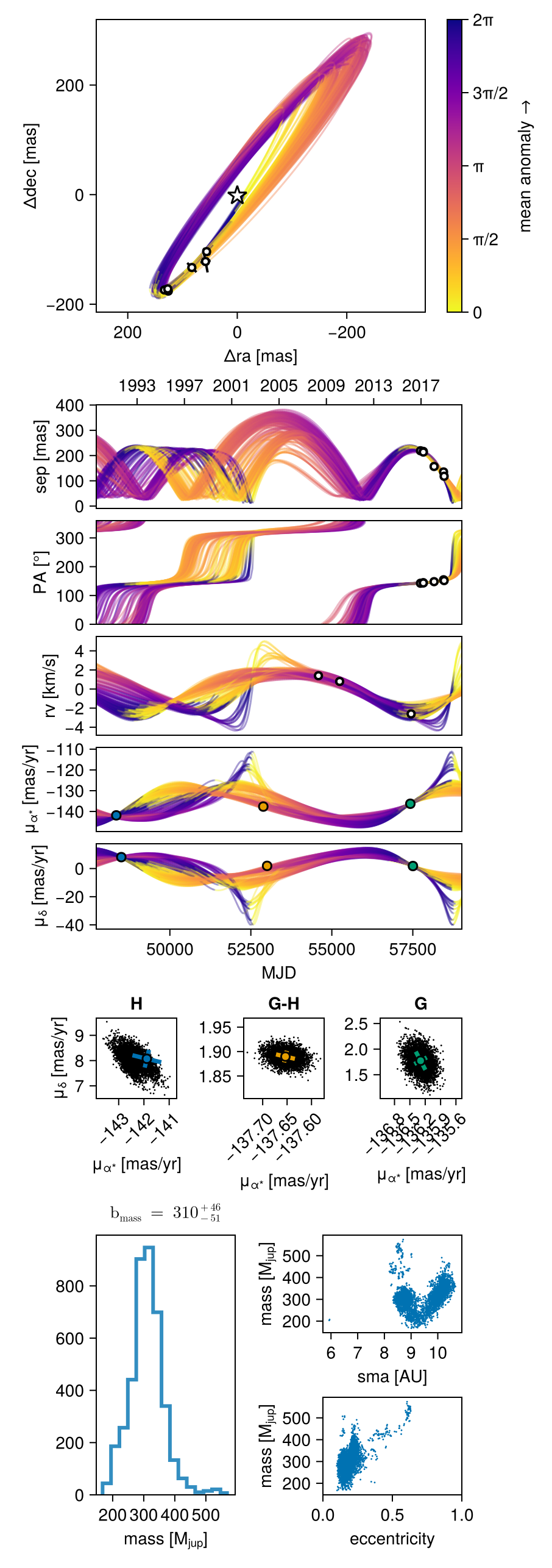
Astrometry also tells us where to look. A planet detected by Gaia comes with a predicted position and brightness, so telescopes like JWST can point straight at it. That turns direct imaging from a blind search into the follow-up of known planets, and lets us measure the atmospheres of planets that are older, colder, and more like Jupiter than the young planets imaged so far.
Further reading
- ESA's Gaia pages, including what DR4 will contain
- Perryman et al. 2014, predictions for planet discoveries with Gaia
- Brandt 2021, the Hipparcos–Gaia Catalog of Accelerations
- Thompson et al. 2026, the G23H catalog and method
- Octofitter, open-source software for joint orbit fitting
- Exopost, companion posteriors for more than 100,000 stars
Last updated October 2026
🐙